

Acne is supposed to be a problem you outgrow, like curfews and algebra. So it feels like a clerical error when, at 44, with a mortgage and a teenager of your own, you wake up to a cluster of tender bumps along your jaw.
It is not an error. In a well-known survey published in the Journal of the American Academy of Dermatology, about 26 percent of women in their 40s reported acne. For women in their 50s, the figure was 15 percent. Men, by contrast, largely age out. Adult acne is, overwhelmingly, a women's condition, and the reason is mostly hormonal.
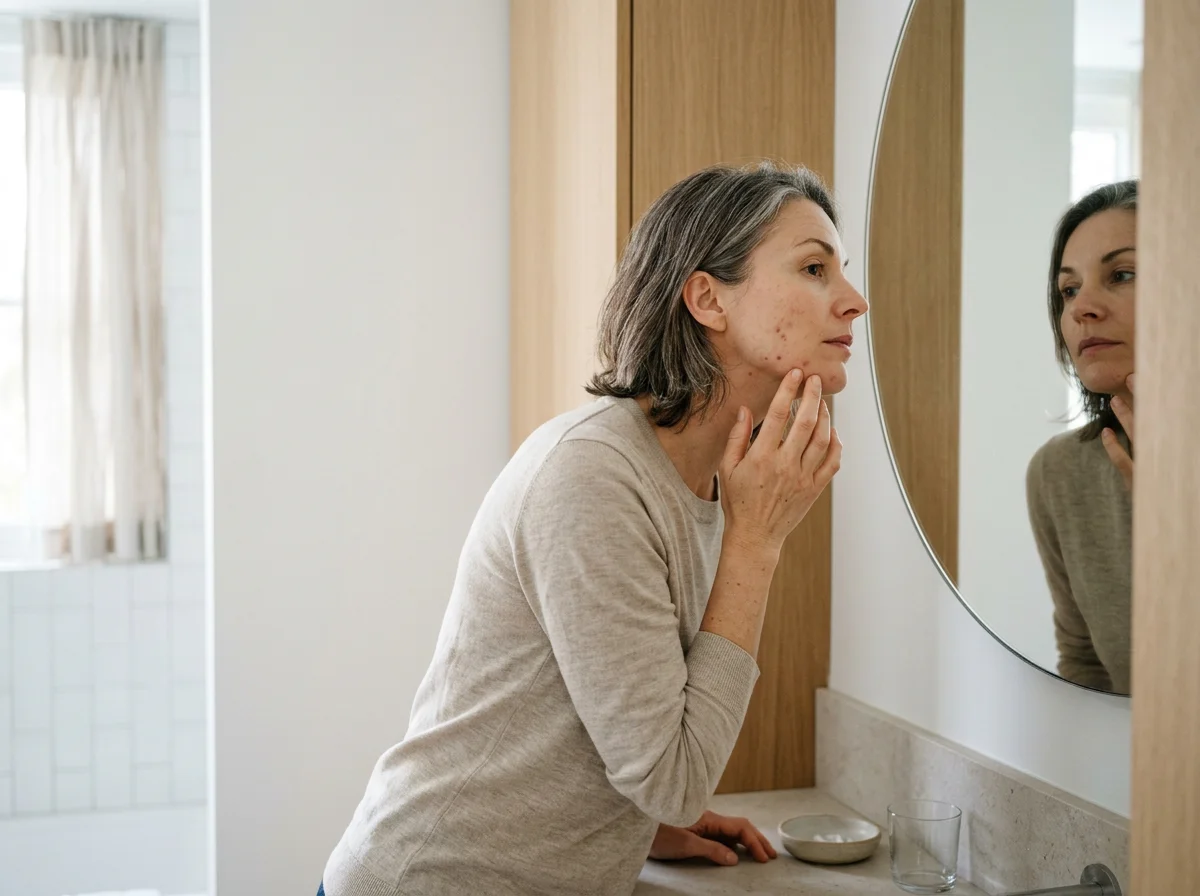
Why acne comes back after 40
Oil glands in the skin are run by androgens, the hormones usually labeled "male" but made by every woman's ovaries and adrenal glands. Androgens enlarge oil glands and thicken their output. Estrogen pushes the other way, and it raises a protein called sex hormone–binding globulin (SHBG), which handcuffs testosterone in the bloodstream.
Perimenopause, which can begin in the early 40s, scrambles this balance. Estrogen swings and then falls. SHBG drops. Testosterone itself barely changes, but more of it circulates free. The skin, which responds to free hormone, behaves as if androgen levels rose. That is why adult acne has a signature: deep, sore bumps on the jawline, chin and neck, often flaring before a period.
Several accomplices make it worse:
Stopping birth control. Many women spend two decades on the pill, which suppresses androgens. Stop it in your 40s and the skin you had at 19 reappears.
Weight gain and insulin resistance. High insulin lowers SHBG and stimulates the ovaries to make androgens. It is the same engine that drives PCOS.
Stress and poor sleep. Both raise cortisol and adrenal androgens.
Diet. The evidence is modest but consistent: high-glycemic foods and skim milk are linked to more acne.
Products. Heavy moisturizers, hair oils and anti-aging creams can block pores. So can a face mask worn for hours.
Medications. Testosterone or DHEA creams, some progestin-only contraceptives, lithium and corticosteroids can all trigger breakouts.
When acne is a hormone problem, not a skin problem
Most adult acne needs no blood test. But acne can be the first visible sign of an endocrine disorder, and it is worth checking when it travels with other clues:
New coarse hair on the chin, upper lip, chest or abdomen
Thinning hair at the crown
Irregular or absent periods
Weight gain around the middle, darkened skin folds (a sign of insulin resistance)
Acne that does not respond to standard treatment
In that setting, an endocrinologist will look for polycystic ovary syndrome, which does not go away at 40; non-classic congenital adrenal hyperplasia; thyroid disease; and, rarely, Cushing's syndrome. Useful tests include total and free testosterone, DHEA-S, 17-hydroxyprogesterone, prolactin, TSH and a measure of insulin resistance, ideally drawn in the morning and, if you still cycle, early in the cycle.
One pattern is urgent. Acne that appears with a rapidly deepening voice, fast-growing body hair or an enlarging clitoris over a few months suggests an androgen-secreting tumor of the ovary or adrenal gland. It is rare, and it is treatable, but it should be evaluated within weeks, not months.
What actually works
Treatment is layered. Most women need two or three tools at once, and every one of them takes eight to twelve weeks to show its effect, which is why so many are abandoned too early.
Topicals first. A retinoid (adapalene, available without a prescription, or prescription tretinoin) unclogs pores and, as a bonus, is the best-studied topical for fine wrinkles. Benzoyl peroxide kills acne bacteria without breeding resistance. Azelaic acid helps both acne and the dark marks it leaves, and it is gentle on the dry skin of perimenopause.
Spironolactone. This old blood-pressure pill blocks androgen receptors in the skin, and for hormonal acne in adult women it is often the most effective single step. A randomized trial published in The BMJ in 2023 found it improved acne and quality of life compared with placebo. It is inexpensive and generally well tolerated; potassium and kidney function may be checked in some women, and it must not be taken during pregnancy.
Clascoterone. A newer prescription cream (Winlevi) that blocks androgens directly in the skin, without affecting the rest of the body.
Combined birth control pills. Effective, but in the 40s the risks of blood clots and stroke deserve a careful look, especially for smokers and women with migraine with aura, high blood pressure or obesity.
Isotretinoin. For severe or scarring acne, it remains the only treatment that can produce lasting remission, and it works in adults as well as teenagers.
Fix the metabolic engine. When insulin resistance is part of the picture, losing even 5 percent of body weight, strength training and, when appropriate, metformin or a GLP-1 medication can lower androgen activity and calm the skin.
A word on menopausal hormone therapy: it is not an acne treatment, and some formulations, particularly those containing testosterone or certain progestins, can make breakouts worse. If you are weighing it for hot flashes, sleep or bone health, skin is one more factor to discuss.
Habits that help, and myths that don't
Wash twice a day with a gentle cleanser. Scrubbing harder inflames skin; it does not clean it better.
Choose products labeled "non-comedogenic," and keep hair oils off the hairline.
Do not pick. Squeezed lesions scar and darken, and dark marks last longer in your 40s than they did at 16.
Chocolate is mostly innocent. Sugar-heavy, refined diets and large amounts of milk are the more plausible culprits.
Sunscreen matters, because retinoids and acne marks both make skin more sensitive to sun.
The bottom line
Acne in your 40s is common, it is usually hormonal, and it is very treatable. Start with a retinoid and benzoyl peroxide. If the jawline still flares after three months, ask about spironolactone. And if acne arrives with unwanted hair, thinning scalp hair or irregular cycles, see an endocrinologist, because the skin may be telling you something about your hormones.
At Chia Endocrinology & Wellness in Wexford, I evaluate women for the hormonal causes of adult acne, hair loss and perimenopausal changes, in person or by telehealth across Pennsylvania and Ohio. Book an initial consultation.
This article is for general education and is not a substitute for personal medical advice.
